




Tel: +86 18255112898
Email: salehongfeng@163.com
 中文
中文
Tel: +86 18255112898
Email: salehongfeng@163.com
中文
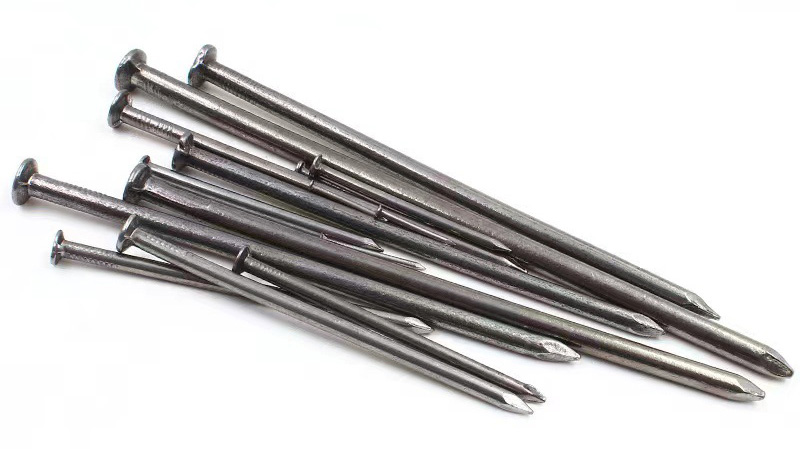
Wobbly Tables/Chairs "Stabilized in Seconds": Is your solid wood dining chair leg wobbly? Is your wardrobe shelf slipping down? Grab 2-3 50mm-long common nails and drive them diagonally into the "hidden" parts of the furniture—like the gap between the chair leg and seat, or the joint between the shelf and side panel. No need to twist screws; a few taps will secure it firmly, and you’ll never have to worry about the chair "squeaking" during meals again.
Turn Scrap Wood into Storage: Got leftover wood planks at home? It’s super easy to build a small bookshelf or storage box with 30mm-50mm short common nails. When assembling the frame, drive 2 nails at the joint of each plank; for shelves, choose 25mm thin common nails—they’ll hold securely without splitting thin wood, even for beginners.
Easily Install Simple Shelves: Want a small shelf in the entryway for keys? For brick or plaster walls, first drill a hole slightly thinner than the common nail, then drive a 50mm-75mm common nail into the hole, leaving a small section of the shank exposed to hang the shelf. For wooden walls, just drive the nail directly—it takes 5 minutes, much easier than installing expansion screws.
A Place to Hang Small Items: Drive a few 30mm short common nails inside your bedroom wardrobe to hang scarves and hats without taking up space. On the balcony wall, drive 50mm-long common nails to hang a small laundry rack or storage bag. Vertical space is instantly utilized, and you’ll no longer have messy piles in the corner.
Secure Photo Walls & Decorative Paintings: For hanging decorative paintings or photo frames weighing no more than 2kg, common nails are more invisible than hooks. For wooden frames, drive 1-2 25mm short common nails into the back, leaving a small part of the point exposed to hang on a wall hook. If nailing directly into a wooden wall, choose 30mm common nails and drive them secretly from the edge of the frame—no visible nail marks, so aesthetics aren’t compromised.
"Quick Nailing" for Holiday Decorations: When hanging festive lights during Chinese New Year or lanterns for Mid-Autumn Festival, 20mm-25mm ultra-thin common nails are perfect. Drive a few into the corners of the living room ceiling or along wall edges, wrap the light strings around them, and hang ribbons—creating a festive atmosphere effortlessly. For outdoor courtyards, choose 75mm-100mm galvanized common nails; drive them into tree trunks or railings to hang lanterns, and they won’t rust in the rain.
Mini Ornaments "Come to Life": Use small wood chips to make wooden teddy bears or tiny houses. 30mm common nails work as "connectors" to assemble the head, body, and limbs. Then, use 20mm thin common nails as "eyes" or "windows"—adjust the length of the exposed nail to create 3D details, which adds more texture than just gluing.
Carving Stamps "No Slipping": When carving wooden stamps, the biggest fear is the wood block moving. Grab 25mm-30mm common nails and drive them into the workbench from the edge of the wood block (avoiding the area to be carved). The block will stay fixed, allowing for more precise carving. After finishing, tap the end of the nail to remove the block—no marks left on the workbench.
Fabric Works "Stay Taut": When making a fabric tapestry, drive 30mm-40mm common nails into a wooden frame (one every 5cm-8cm). Then, weave yarn or fabric scraps between the nails to create patterns. When sewing fabric dolls, use 18mm thin common nails to fix the stuffing inside the doll’s head and body—no more shifting stuffing, and the doll keeps its plump shape.
Clay Models "Stand Firm": When making tall towers or figurines with ultra-light clay, they easily collapse without support. Insert 1-2 50mm-75mm common nails as a "skeleton" before covering with clay—the tower won’t fall over. For the arms and legs of clay figurines, insert 25mm thin common nails inside to keep them straight and prevent sagging.
Greenhouses "Wind-Resistant": After building a greenhouse frame with bamboo poles, use 30mm-40mm galvanized common nails to fix plastic sheeting or shade nets. Drive the nails along the edge of the sheeting into the bamboo poles—even strong winds won’t blow it off. Use common nails to fix curtains at the greenhouse door and vents to block cold air and improve insulation.
Farm Fences "Animal-Proof": Worried about chickens or rabbits entering the field and damaging crops? Build a fence with wooden stakes and wire mesh. First, drive 150mm-200mm long common nails into the ground (50mm-80mm deep) to secure the stakes. Then, use 50mm-75mm common nails to fix the wire mesh to the stakes (3-4 nails per stake)—the mesh stays tight, and animals can’t squeeze through.
Old Tools "Fixed for Reuse": Is the wooden handle of your hoe loose? Did a tine fall off your wooden rake? When repairing a hoe, drive 2-3 50mm-75mm common nails into the joint between the wooden handle and metal head—it’s stronger than just gluing. For wooden rakes, use common nails to reattach loose tines—the tool works like new, no need to buy a replacement.
Crops "Stand Straight": Climbing crops like cucumbers and tomatoes, and tall crops like corn, easily fall over. When growing cucumbers, build a bamboo pole frame and use 30mm-40mm common nails to fasten the crossed poles into a triangular support. Tie the cucumber vines to the frame. When corn is nearly ripe, insert a wooden stake next to the stalk and gently fix the corn stalk to the stake with a common nail (don’t hit too hard to avoid damaging the stem)—it won’t fall over in strong winds.
Construction Fences "Cost-Saving": When building wooden or bamboo fences, 75mm-100mm common nails are perfect. For wooden fences, drive 2 common nails per plank (top and bottom) to fix them to the stakes. For bamboo fences, use 50mm-75mm common nails to join bamboo strips—it’s half the cost of screws and easy to disassemble.
Temporary Guards "Safety-First": For guardrails along temporary construction paths, assemble a frame with wooden poles and fix the joints with 50mm-75mm common nails. Drive 30mm short common nails to hang safety signs. Use common nails to fix safety nets and warning tapes between construction and non-construction areas—simple and safe.
Ceiling Joists "No Misalignment": When installing wooden ceiling joists, first use 30mm-50mm short common nails to temporarily fix the joists to the wall and ceiling. After adjusting for flatness, permanently secure them with self-tapping screws. Common nails help "position" the joists to prevent misalignment. For soundproof cotton and moisture-proof paper in light steel stud partitions, common nails also work—just a few taps, more durable than tape.
Wall Leveling "Pro Tip": Before pasting wallpaper, if there are small bulges on the wall, gently drive 20mm-25mm ultra-thin common nails into them to flatten the surface. When installing wooden crown molding or waistlines, first use common nails to temporarily fix the strips from hidden edges. After adjusting for straightness, reinforce with glue or screws—no more crooked strips.
Length: Short Nails for Light Fixing, Long Nails for Load-Bearing
Diameter: Thin Nails Prevent Splitting, Thick Nails for Strong Grip
Surface Treatment: Regular Nails for Indoors, Galvanized Nails for Outdoors
Key Differences Between Cold-Galvanized Iron Wir
Coil Nails
Contact: Fan
Phone: +86 18255112898
Tel: 0551-82311088
Email: salehongfeng@163.com
Add: No. 8, Circular Economy Industrial Park, Zhangpu Town, Tianchang City, Chuzhou City
We chat